Generating AI Summary...
Introduction: Beyond the Hype It’s impossible to ignore the headlines. A constant stream of predictions, often from industry giants like Microsoft, proclaims that Agentic AI will soon make Software-as-a-Service (SaaS) obsolete. The narrative is simple and dramatic: intelligent agents will...
Introduction: Beyond the Hype
It’s impossible to ignore the headlines. A constant stream of predictions, often from industry giants like Microsoft, proclaims that Agentic AI will soon make Software-as-a-Service (SaaS) obsolete. The narrative is simple and dramatic: intelligent agents will rise, and traditional software will fall.
But the reality of what’s happening at the intersection of AI and enterprise software is far more complex and interesting than a simple replacement story. The “AI kills SaaS” debate is a red herring. The real transformation is happening in the messy details of pricing, the fundamental definition of software value, and the very architecture of how businesses operate. Forget the extinction event; what’s really unfolding is a surprising and profound evolution.
1. The “Death of SaaS” Is the Oldest Hype in Tech
The prediction that a new technology will completely eradicate an old one is a recurring and often incorrect theme in the tech industry. While Microsoft corporate vice president Charles Lamanna predicts AI agents will make traditional business applications “the mainframes of the 2030s,” history suggests this doesn’t mean they will disappear. In fact, it often means the exact opposite.
This pattern of “tech-killers” that never quite kill has played out for decades. Consider these historical examples:
- The 1960s prediction that COBOL would eliminate the need for software developers.
- The 1990s prediction that 4GL/”low-code” products would let business analysts replace developers.
- Microsoft’s own past prediction that PCs would replace mainframes, which are still in use today.
A Bain & Company analysis reinforces this point, arguing that technology transitions are rarely binary and instead create a “mix of old and new models.” This heterogeneity persists because enterprises don’t make decisions on technology alone; they navigate a complex trade-off between flexibility, control, compliance, security, and cost. The most likely outcome isn’t replacement, but expansion.
“The lesson from history is clear: Transitions expand ecosystems rather than replace them outright.”
2. The Real Revolution Isn’t Software, It’s the Price Tag—And It’s a Mess
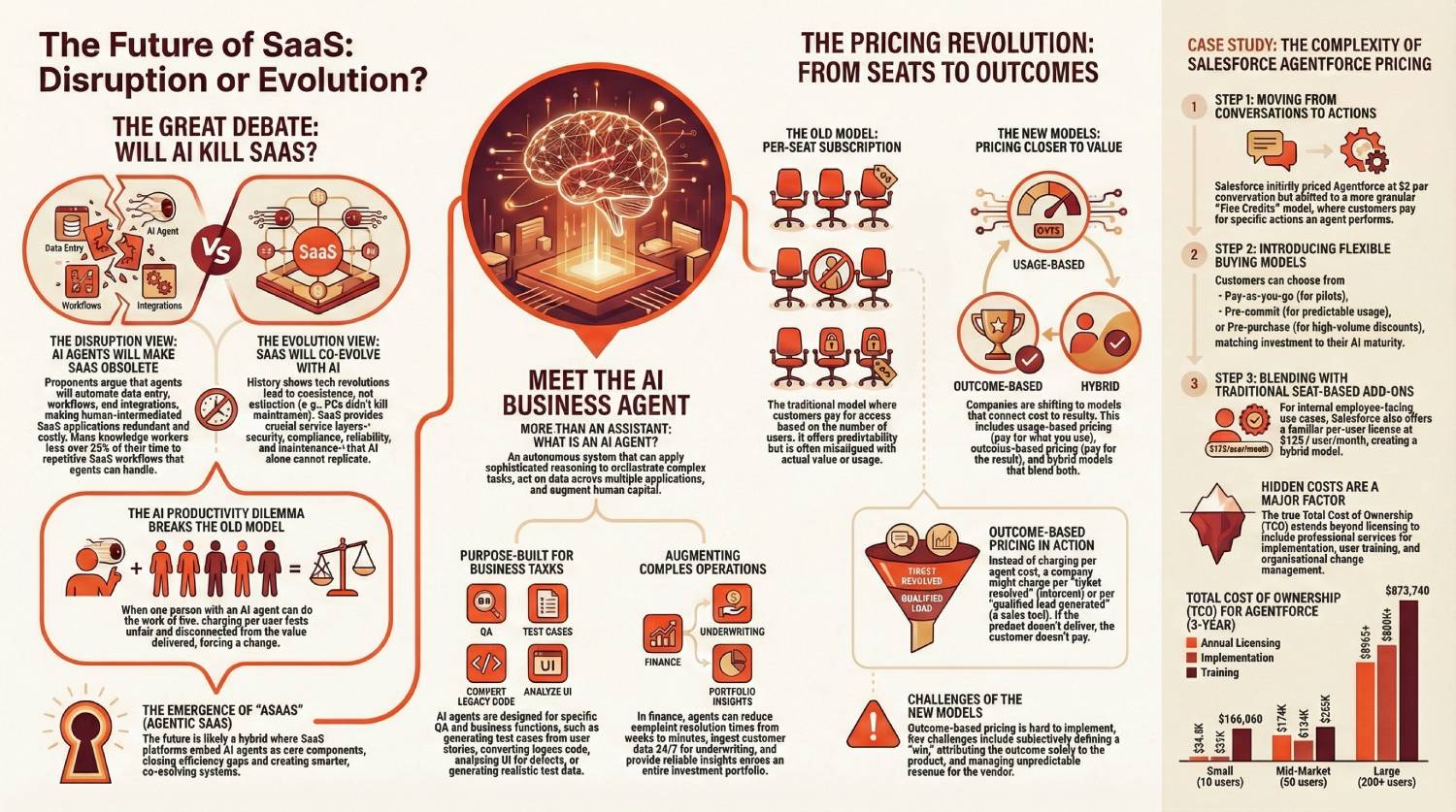
While the AI vs. SaaS debate grabs headlines, the real, immediate disruption is happening in how software is monetized. The theoretical ideal that everyone wants is “outcome-based pricing,” a model that promises perfect alignment between a vendor’s revenue and a customer’s success.
The counter-intuitive reality, however, is that pure outcome-based pricing is extremely difficult to implement and often fails in practice. The dream collides with a messy reality for several key reasons:
- Defining the “Outcome”: What constitutes a “win” can be subjective and vary wildly across different teams using the same tool. For a product like Zapier Agents, a successful outcome for a support team (tickets deflected) is completely different from a successful outcome for a marketing team (content volume lift).
- Attributing the Cause: Proving a specific software caused a business result is the model’s “Achilles Heel.” Business outcomes are often influenced by dozens of external factors, making direct attribution nearly impossible to prove and bill against.
- Predicting the Cost: Vendors face massive uncertainty, as the cost to deliver an outcome can swing wildly based on a customer’s data quality, integration depth, and usage intensity.
Attempting to force a pure outcome model before the market is ready can backfire, creating more confusion than confidence.
“You can think, we’re gonna win deals because we’re using this new pricing model, when all you’re really doing is confusing customers if they’re not quite there yet.” — Rita Sherman, Senior Director, Pricing Strategy, Gong
As a result, an interesting trend is emerging: companies are using outcome-based pricing as a marketing message while actually billing on more controllable proxies, like “units of work” or “per conversation,” to provide predictability for both themselves and their customers.
3. You Can “Vibe Code” a Project, But You Can’t Vibe Code a Business
A popular myth suggests that AI will empower anyone to build their own replacement for mature SaaS products. This narrative of “vibe coding”—using natural language prompts to create functional apps in an afternoon—fundamentally misunderstands the value proposition of SaaS, which, despite its name, was never primarily about the “software”—it was always about the “service”.
There is a critical difference between a software “project” and a SaaS “business.” While AI can generate the former, it cannot replicate the latter.
“It’s easy to vibe code a project, but it’s incredibly hard to vibe code a business.”
The “service” component of SaaS is a complex, operational machine that AI-generated code alone cannot provide. It is the invisible infrastructure that makes enterprise software reliable, secure, and usable at scale.
What SaaS Manages Beyond the Code:
- Ongoing security patching and threat management.
- Compliance, data governance, and privacy.
- Scaling infrastructure reliably without downtime.
- Continuous updates, bug fixes, and user support.
- Handling customer service and integration requests.
While AI can generate a tool, it cannot replicate the years of refinement and operational expertise required to run a secure, scalable, and reliable enterprise-grade service.
4. SaaS Isn’t Dying; It’s Becoming the Essential “System of Record” for AI
Instead of being replaced, SaaS is solidifying its role as the indispensable “system of record” that will power the AI revolution. For business-critical functions, a conversational chat with an AI is simply not enough. Businesses require structured, legally certain, and auditable data because, as one analyst notes, “nobody is going to accept responsibility for the machine getting it wrong when their are lives or a lot of dollars on the line.”
There must be a source of truth that can be audited, verified, and legally defended. This is where SaaS platforms excel.
“Even if you replace the front end completely with AI and AI agents (somehow), you still need that data repository.”
The future architecture emerging from this reality is clear: AI agents will act as the new “system of engagement,” where users interact with them to perform tasks and get information. But behind the scenes, robust SaaS platforms will provide the underlying data integrity and business logic as the “system of record,” ensuring that every transaction is structured, secure, and auditable.
5. The Future Isn’t Replacement, It’s “ASaaS” (Agentic SaaS)
The most accurate vision of the future is not replacement but “co-evolution.” This new model is already being called ASaaS (Agentic SaaS), which involves embedding autonomous AI agents directly into existing SaaS applications. These agents can automate complex workflows, handle data entry, generate insights, and execute tasks without human intervention.
This trend is being driven largely by IT service providers with deep AI experience who, as trusted partners, know exactly where their customers’ operational friction exists. Early adopters are already reporting significant productivity gains, with marketers and finance teams reducing time spent on manual data entry by over 30%.
The ultimate vision of ASaaS is a move towards conversational interfaces where users interact with voice commands—”Like Alexa or Siri—but for enterprise work.” A user might say, “Summarize my top five sales opportunities and draft follow-up emails,” and the agent will execute the command using the underlying CRM platform.
This isn’t about killing SaaS. It’s about helping it “shed inefficiencies and evolve.” The foundational SaaS platform remains to provide structure and reliability, but its functionality and user experience are being fundamentally transformed by a new layer of intelligent, autonomous agents.
Conclusion: A New Layer, Not a New Slate
The “AI kills SaaS” narrative is a dramatic oversimplification of a much more fascinating reality. The true story is one of messy but exciting transformation, defined by the chaotic shift to hybrid and proxy-based pricing models; the renewed focus on the operational “service” as the true moat against “vibe coding”; and the architectural evolution of SaaS into the auditable “system of record” for AI agents.
As AI agents become the new face of software, how will we measure the value of the quiet, reliable systems running everything behind the scenes?